- The domain name, Mask-Rider.net,
is taken from the Tactical Voice Radio Call Sign of the ship
I served in during the Vietnam War. That ship was the USS Richard
B. Anderson, DD786. She was a beautiful old low-slung Gearing
class tin can home-ported in Yokosuka, Japan. She was a FRAM
I Class AA conversion.
-
- The ship's call sign was actually
Masked Rider. However, as that domain name was already in use
(by some Japanese anime character) I opted instead for Mask-Rider.net.
Since a lot of my scenery-making imagery work involved the use
of masks I thought it not a bad compromise!
-
- The Anderson was named in
honor of Marine PFC Richard B. Anderson, killed on Roi Island,
Kawajalein Atoll, Marshall Islands, 1 Feb 1944. The circumstances
of his death resulted in his being posthumously awarded the Congressional
Medal of Honor. He is buried at the New Tacoma Cemetery, Tacoma,
Washington.
-
- During gun fire support and
other evolutions we always flew our "Best
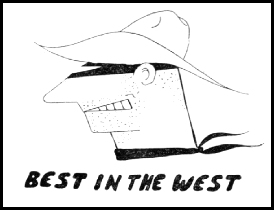 In the West" battle pennant. The pennant sported the little
Masked Rider image shown at right. The Mask-Rider logo is based
on the image from that pennant.
In the West" battle pennant. The pennant sported the little
Masked Rider image shown at right. The Mask-Rider logo is based
on the image from that pennant.
-
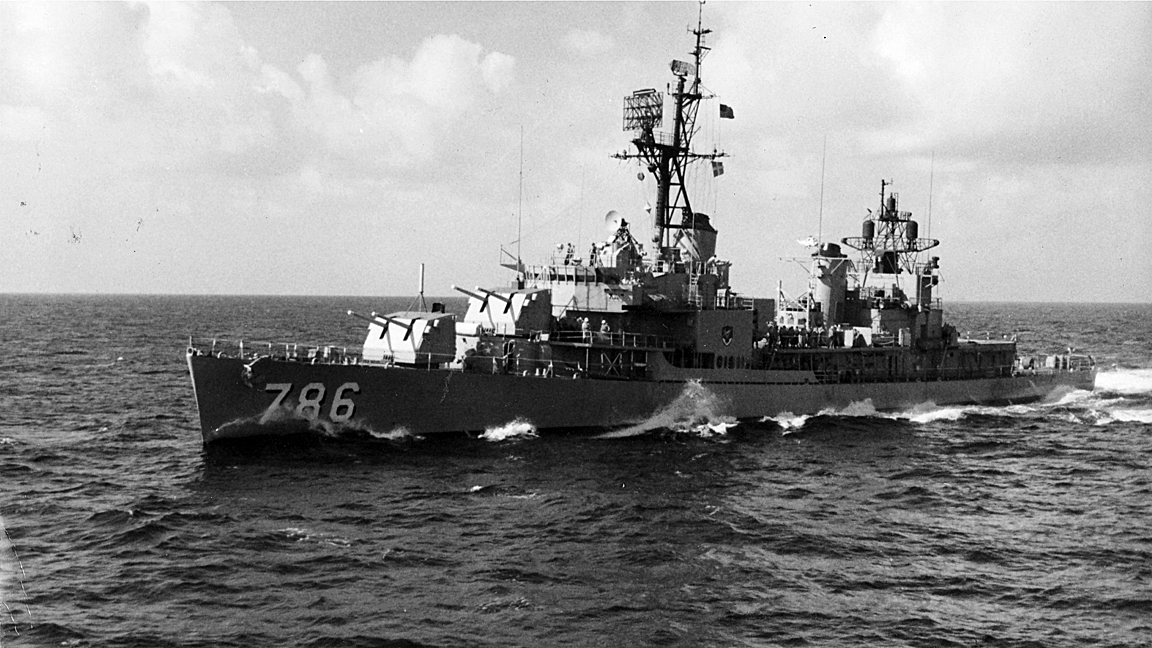
- The photo above was taken
as the Anderson was making her approach for an underway replenishment
(UNREP or UNREPPING). Yours truly is standing somewhere in the
midships unrepping station, the Torpedo/ASROC deck, where AS
Division was responsible for taking on ammo, stores, mail, movies
and, occasionally, personnel.
-
- After completing an underway
replenishment the ship would do a hard 90-degree starboard turn
and kick it in the ass- go from 2-3 knots up to 35 knots in less
than a minute. As we heeled way over to port, re-rigging the
lifelines and stowing away the hi-wire gear, the XO would come
over the 1MC and cry- "Hi Ho Silver- away!" followed
by the William Tell Overture being played full blast (ala The
Lone Ranger TV show).
-
- It was was fun! After all,
we were young, invincible and quite frankly- a bunch of seagoing
renegades! But at the same time we were good sailors first,
last and always! We took great pride in our professional seamanship
and underway skills and had a well-earned WestPac, 7th Fleet
reputation as such. We were bad-ass!
-
- We spent way more time underway
and away from Yokosuka than we did in Yokosuka. But whenever
we returned from sea and approached the entrance to Tokyo Wan,
it was always a thrill to see Mount Fuji emerge from the early
morning mist. Even though we were American sailors, the view
of Mt Fuji as we sailed into Tokyo Bay always felt like coming
home. It is a beautiful sight.
-
- The Dickie B, as we
affectionately called her, saw continuous active duty from her
commissioning in 1944 until her decommissioning in 1976. She
went on to serve another 20 years with the Republic of China
(Taiwan) Navy as ROCS Kai Yang (DDG-924) until her final decommissioning
in July, 1999.
-
- After serving two republics
for 55 years the Anderson was a bit long in the tooth and ready
for the boneyard. Loyal crew members traveled to Kaohsiung, Taiwan
in February 2000 to accept artifacts from the ship that were
graciously presented by the ROC Navy. These artifacts included
the engine order telegraph and ships wheel from the bridge and
the ships bell. The ships' artifacts are on display at the Richard
B. Anderson Memorial in Veterans Memorial Park, Port Angeles,
Washington. The memorial was funded affectionately by donations
from crew members.
-
- BTW, yours truly hit his head
on that ships bell while running full-tilt to his abandon ship
station during his first abandon ship drill on his first day
underway heading to Keelung, Taiwan. The bell was mounted on
the forward bulkhead of the bridge superstructure just behind
mount #2. You seagoing types can pick out that spot out in this
pic.
-
- USS Richard B. Anderson earned
a total of fifteen engagement stars: Four for service during
the Korean conflict, four more for separate actions in Armed
Forces Expedition Operations (Quemoy-Matsu, Korea, and Vietnam,
two), and seven during tours in the combat waters of Vietnam.
She was awarded the Secretary of the Navy's Meritorious Unit
Commendation three times, in addition to the Humanitarian Service
Medal, and her personnel earned the Combat Action Ribbon five
times.
-
- Other interesting facts about
the Anderson: (1) She co-starred in the movie "The Caine
Mutiny". She is the ship filmed getting underway and steaming
out of San Francisco Bay at the end of the movie as Willie Keith’s
new ship; (2) She was one of 46 USN Surface Warfare ships that
took part in the evacuation of Saigon in April-May 1975; (3)
In May 1962 she conducted the only open-ocean, live-fire test
of an ASROC (Anti-Submarine Rocket) armed with a nuclear depth-charge
warhead.
-
- At the risk of being labeled
a misogynist-sexist, I am proud to say that the Dickie B. was
Old Navy all the way. She never saw a female crew member
cross her quarter deck. She sailed the seas when there was no
internet, no satellite TV, no cell phones. So, when we were underway,
we were gone.
-
- The Anderson was part of the
scenery in old Hong Kong, Subic Bay, Loag, Manila, Bangkok, Panang,
Keelung, Kaohsiung, Pusan, In Chon, Chin Hae, Yokosuka and many
other ports of call. She was a fine ship and many fine young
and old salts served in her.
-
- She always brought us home
safe.
-
- On our last night in Yokosuka
before getting underway for the States and eventual decommissioning,
we went bar-hopping through the Honcho. As we went from bar to
bar we sang the following little ditty to the tune of Frère
Jacques:
-
- "Sayonara! Sayonara!
- Nippon! Nippon!
- Nana hachi roku! Nana
hachi roku!
- Ichiban! Ichiban!"
-
- Roughly translated:
-
- "Goodbye! Goodbye!
- Japan! Japan!
- Seven-eight-six! Seven-eight-six!
- Number one! Number
one!"
|